13/03/2026
News
13/03/2026
AI4REALNET part of workshop on Quantified Occupational Health
In the scope of the work developed within the AI4REALNET project, INESC TEC promoted the workshop entitled “AI technologies for monitoring workplaces and occupational health”, focused on how artificial intelligence (AI) strategies can be leveraged to build efficient and automatic tools that are able to assist and monitor workers’ health, security and performance during labour activities.
One of the professional groups featured in the workshop was the technical operators, who manage critical networks in areas such as power systems, air traffic and railway, reaching the framework of the AI4REALNET project. Shedding a light on the most recent results and ambitions from several ongoing projects, the program brought together a dynamic and diverse group of researchers coming from INESC TEC, Deutsche Bahn and the University of Dresden, to explore new perspectives on supporting and improving workers’ physical and mental well-being.
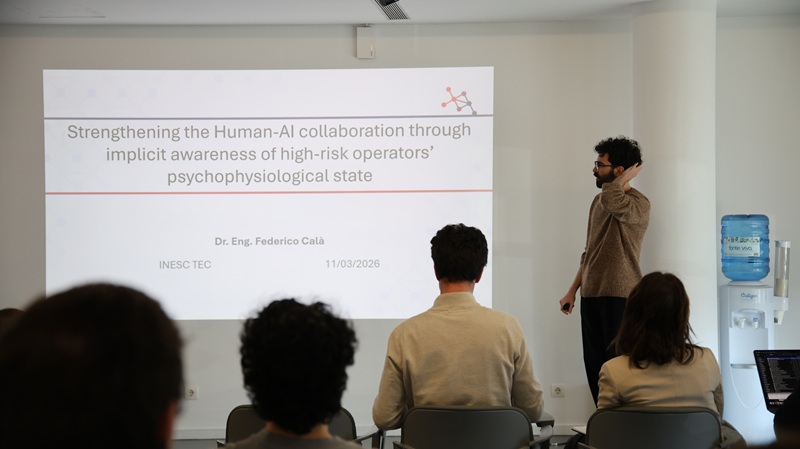
Federico Calà, researcher in Bioengineering from INESC TEC working at the AI4REALNET project, talked about “Strengthening the Human-AI Collaboration Through Implicit Awareness of High-Risk Operators’ Psychophysiological State”, following the broader research line at INESC TEC that focuses on determining how does technology enhance/facilitate the creation of safe and healthy workspaces, presented by Duarte Dias, also a researcher on the Bioengineering area at INESC TEC.
Roman Liessner, an AI Innovation Manager at Deutsche Bahn and partner on the AI4REALNET project, presented future perspectives on how humans and AI systems can collaborate to achieve superior outcomes on complex environments, namely in rail industry.
Finally, Magdalena Wekenborg and Elizabeth Michels, from the Else Kröner Fresenius Center for Digital Health at TU Dresden, shared with the audience their research and future perspectives on biopsychology and psychophysiology of stress and fatigue and the development of supportive, stress-reducing human–AI interactions in digitalized work environments, focus on clinical settings workers.
During the afternoon, multiple domains were approached, from reinforcement learning to biomedical engineering, wearable devices and psychology, each one of them with a shared emphasis on prioritising workers’ well-being, especially in safety-critical environments. In the end, all guests participated in a round table, that allowed attendees to share their opinions and suggestions and gave the audience an opportunity to acknowledge new perspectives and create new research synergies.
This event took place on March 11 at INESC TEC, and featured, beyond the AI4REALNET, Crops&Care and s2IO projects, which results were also presented during the workshop.